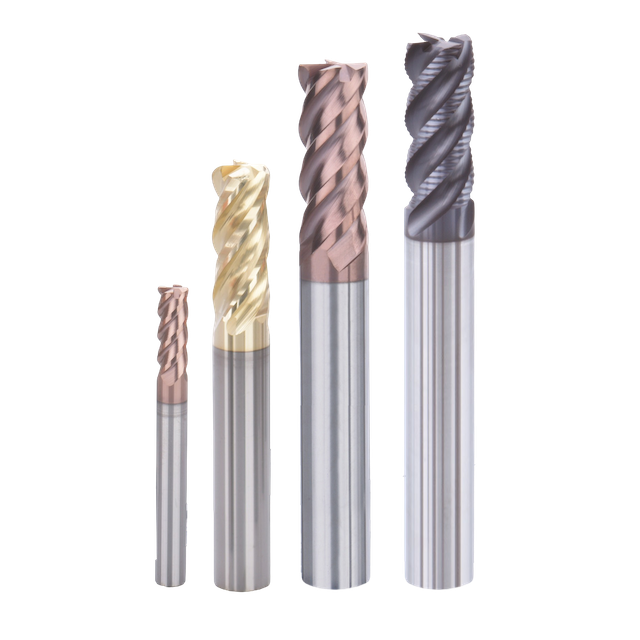
Carbide End Mills - Types, Benefits, and Tips
End mills do most of the metal removal in a milling shop, and the type you pick changes surface finish, tool life and cycle time. Flat (square), ball nose, corner radius and chamfer each have a job they are good at. This page covers what the differences mean in practice and what we stock.
Key Takeaways
Types of Carbide End Mills
The profile you choose has a direct effect on surface quality, tool life and how hard you can push the cut. Below are the four types we stock and where each one belongs.
Square End Mills
Square (flat) end mills cut a flat bottom and a true 90 degree corner. They are the default choice for slotting, side milling and general work, and they run in everything from aluminum to hardened steel.
Flute count and shank diameter matter more here than most people expect. More flutes give a better finish and let you push feed, but leave less room for chips - which is why aluminum wants fewer flutes and steel tolerates more. A larger shank relative to the cut adds rigidity and reduces chatter on deeper passes.
Corner Radius (Bull Nose) End Mills
A corner radius end mill is a square end mill with the sharp corner replaced by a small radius, typically R0.010" to R0.030". That corner is where a square end mill usually fails first, so moving load off it is the cheapest way to extend tool life in steel, stainless and heat-treated material.
The trade-off is the radius it leaves in the corner of your pocket or shoulder. If the print allows it, a corner radius tool will outlast a square one doing the same job. If you need a sharp internal corner, use square.
Ball Nose End Mills
Ball nose end mills have a full radius tip for contoured and 3D surfaces - mould and die work, sculpted geometry, finishing passes. Cutting pressure stays consistent as the tool follows a curve, which is what gives the surface finish. Note that cutting speed drops to zero at the very tip, so a small step-over and a tilted tool axis, where the machine allows it, both help.