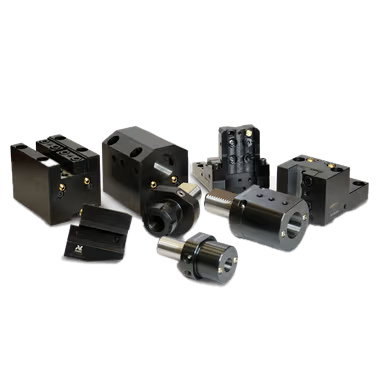
Static tool holders for CNC lathes, stocked in Canada. BMT and VDI turret blocks for OD turning, facing, boring bars, indexable drills, parting blades, collet and drill chucks. Prices and stock on every product page, order without asking for a quote.
The turret decides everything. A tool holder for lathe fits one turret interface and no other, so the first thing to establish is what your machine takes — BMT45, BMT55, BMT60, BMT65, VDI30 or VDI40. Everything after that is which tool goes in it.
These four are the most common, not the whole range. We also supply BMT45, BMT60 in its machine-specific forms — Okuma LB3000EX and LB4000EX, DMG — and blocks for the bolt-on (BOT) turrets that some builders fit instead of a standard interface. Send us the machine model.
On a lathe the workpiece turns in the spindle and the cutting tool is fed into it. On any modern CNC turning centre that tool — insert holder, boring bar, drill or tap — does not sit in the machine directly. It sits in a tool holder for lathe, and the holder sits in the turret. Which turret you have is the first thing to establish; our article on lathe turret types covers the differences.
Why tool holders for lathe turrets are a separate part
It is standardised. The same tool holder lathe block fits any machine with the same turret interface, whatever badge is on the front of it. Change the lathe, keep the tooling.
It comes off the machine. Setting and presetting happen at the bench while the spindle keeps running. That is the whole argument, and it is measured in hours per week.
It is the cheap part that breaks. A tool holder for metal lathe costs a fraction of a turret. In a crash it is usually the holder and the tool that take the damage instead of the machine.
It keeps the turret free. Nothing is committed. Position 1 carries a long boring bar for today's part and a parting blade tomorrow — you are limited by the number of turret stations, not by how the machine was tooled last year.
Types of static tool holders for lathe turrets
A tool holder for metal lathe work is classified by the operation and by the tool it carries. What we stock and can supply:
Radial turning holder (OD)
The most common tool holder lathe block. Takes a square-shank turning tool set perpendicular to the spindle axis for outside-diameter work. A pocket and a clamping plate, nothing more — and nothing to go wrong.
Axial turning holder (OD/FACE)
Built like the radial tool holder for lathe work, but the pocket runs parallel to the spindle axis. Its real job is face grooving, though it will take OD and ID work as well.
Boring bar holder (ID)
For round-shank boring bars working the inside diameter. Usually three clamping screws rather than two, because a bar needs holding over more of its length, and normally two external coolant nozzles aimed at the cutting point.
Indexable drill holder
For indexable drill bodies and U-drills — shanks with a large flat and coolant through the tool. Two screws in line plus a positioning screw from the side. In practice this holder doubles as a boring bar holder, which is why it is the one to buy if you are unsure.
Cut-off blade holder
For flat parting blades. Same idea as the radial holder, but the pocket and clamping plate form a dovetail instead of a square seat.
Morse taper holder
For drills with a Morse taper shank. Some versions have a side window so you can reach the drift or clamping screw without stripping the setup.
Collet chuck holder
For small drills and taps, ER16 through ER32. Runout here is entirely the collet's, not the holder's — a good block with a tired collet still cuts badly.
Drill chuck holder
A conventional jaw chuck on a turret mount, for when the shank size changes constantly and swapping collets costs more time than it saves.
Quick-change tapping holder
For taps, with compression and tension float built in. It absorbs the mismatch between spindle speed and feed, which is what saves the tap on reversal.
Blanks, stops and specials
Bar pullers, stop blocks, plugs and blank blocks for machining to your own drawing. If a job needs a holder that no catalogue lists, a blank block is the starting point — tell us the turret and what has to mount in it.
Which turret do you have
This is the one thing that cannot be worked around, so it is worth being precise about it.
There are really two cases. Either the machine uses a standard interface — BMT or VDI — and the holder is a catalogue part that will outlive the machine. Or the builder fitted its own bolt-on turret (BOT) and the block is made to that pattern. We cover both, so the answer is never that it does not exist. We supply tool holders for lathe turrets in:
BMT55 and BMT65 — the common sizes on modern turning centres
BMT45 — smaller machines and sub-spindle turrets
BMT60 in its machine-specific forms, including Okuma LB3000EX and LB4000EX and the DMG pattern, which are not interchangeable with each other
VDI30 and VDI40 — note that VDI holders come right and left hand, while BMT blocks do not
SKT and the other bolt-on (BOT) turret patterns used by individual machine builders, and one-off blocks made to a drawing
If your machine is not on that list, it does not mean we cannot supply it. Send the machine model and a photo of the turret face.
How to choose a set of tool holders
Two approaches, and which one applies depends on whether you know what is coming through the door next month.
The general job shop set
If the work is unpredictable, tool for the operations rather than for a part. On a ten-station BMT65 turret we would start with:
4 radial turning holders (OD) — OD turning, threading and external grooving are what a lathe mostly does.
2 axial turning holders (OD/FACE) — face grooving needs them, and they add flexibility on OD work.
4 universal ID holders for boring bars and indexable drills — no part gets finished without internal work, and the cylindrical bore also accepts collet chucks, tap holders and bar pullers.
That covers most of what a general shop meets, and leaves the specials to be bought when a job actually demands one. Ten blocks is a real outlay, so buy the tool holder lathe positions you will use every week first and fill the gaps later.
Tooling for a specific part
With a process sheet in hand it is simpler: every cutting tool needs its matching lathe tools holder, and the list writes itself. The part that gets missed is placement — a long boring bar can foul an OD tool in the adjacent station, so those belong on opposite sides of the turret. Work that out before the tooling arrives, not during setup.
Before you order
Check what is already on the shelf. Shops with more than one lathe routinely buy a tool holder for metal lathe they already own, because nobody keeps a list of turret blocks. Ours is the same story — we run our own shop in Calgary and found duplicates the first time we counted.
Buying lathe tool holders from CNCmarket
Every tool holder for lathe turrets that we list is EASYCUT. Prices and stock are on every product page and you can order online without waiting for a quote. Delivery is free across Alberta and we ship anywhere in Canada. Blocks we do not stock are made to order — send the turret type and the drawing.